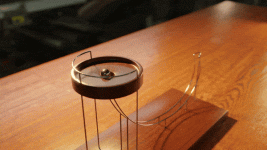
I don’t have a scientific background but have often wondered why a machine that runs on magnets wouldn’t be considered perpetual motion.
Because the total work done by a magnet is zero. An electric motor works with magnets to create mechanical energy, but the motor rotates because external energy (electricity) creates a rotating magnetic field. Conversely, a generator (which is basically the same mechanism in reverse) uses mechanical energy (from wind, water, diesel, etc.) to rotate magnets, which produces a rotating magnetic field that's converted into electrical energy. The magnets themselves add no energy to the system. A stationary magnet produces only a static field. It can pull part of a rotor forward, but at the same time it's pulling another part backward, so the net work is zero.
Similarly, an object in orbit--or, for that matter, a body drifting in a straight line in space--
looks like perpetual motion, but it has no net external force acting on it, so it's just conserving energy, not producing any of its own. In accordance with Newton's first law, it just keeps on doing what it's already doing. Ditto with a superconducting system; since there is zero electrical resistance, it just conserves energy without losing any. None of these systems produce energy or do work. If you tried to extract usable work from them, they would run down (the orbit would decay, etc.)


 . .
. .