Interesting reformed church visit today, a report card.

Much to my shame and admitted ignorance, I don’t have a clue about reading notes, chords, or arrangements. My argument is about the inability to discern authorial meaning or intent. I think the passage that biscuit referred to earlier from Corinthians about an “uncertain sound” carries weight towards that end.

I suspect this is true of many music activists, even the ones claiming expertise: they can talk a good story about chords, instrumentation, rhythm, etc. having moral significance--but when asked to interpret those things, they'll come up dry. Needless to say, I've never seen it done, practically.

Even biscuit's assertion comes down to him not liking extreme metal. Well, neither do I. I'm just not willing to call it wrong or evil without concrete evidence.
 
“You were trying to make it sound stupid. You emphasized the repeated lyrics more than the song itself does. That was disingenuous.”
Down,down,down was growled out 36 times. You can at least be honest about it.
 
Down,down,down was growled out 36 times. You can at least be honest about it.

Sure, if you want. Honestly, you deliberately omitted most of the lyrics that weren't "down, down, down."

As I said ... disingenuous. Trying to paint the song in a poorer light than it actually was. Intellectually dishonest.

Feel free to "agree to disagree." That's what you do when you can't admit you've been cornered and defeated.
 
Chords don’t provide meaning without composition and intent of the composer. When that process happens it enters the realm of morality, as subjective as that may be in making a determination about the nature of the composition.
Chords convey emotion. A major chord is going to convey a light springy feel while a minor chord is going to convey a more somber feeling. The other chords listed are variations of the minor or major chords; some are smooth and take the listener to a safe place while others introduce a bit of dissonance like the tang of vinegar or leave the listener hung out waiting for resolution.

I haven't even gotten into modes. I don't understand them completely; I've heard them described and can relate to the feeling they give music.

I have heard various preeechers yammer on about the power of music to stir up emotions and how ungodly it is to let ourselves be swayed by various music, whether it makes us want to praise God or go out and sin up a storm.
 
Chords don’t provide meaning without composition and intent of the composer. When that process happens it enters the realm of morality, as subjective as that may be in making a determination about the nature of the composition.

Music has an effect on the hearer. A measured and irresistable effect. Like speech, music is an act. An intelligent will is required to make music. You can't find it growing in the woods or dig a mine for it. It is a mode of non-verbal, human communication. It is a work, and will, therefore, be judged as good or evil.

Music is the nonverbal, human communication of mood, demeanor or attitude with a set of tones existing in a specific harmonic relationship with one another arranged in a manner as to elicit a specific emotional response in the listener.

Of course it is moral, and its morality is judged the way any other action or attitude is judged.
 
R.C. Sproul discusses music and its impact on us. You don’t have to be a music major to realize how we are influenced by it in a negative or positive way.

(11:13) “I’ve seen two interviews of young murderers on death row – two different interviews, two different guys – both of whom murdered their parents as part of an initiation ritual for a satanic cult. So in order to prove themselves worthy of the cult, they carried out the massacre of their own parents. And in both interviews, these young people were asked how they progressed from their childhood thinking and worldview to this kind of behavior... Both of them said that they had a straight line in their experience from their addiction to hard-core pornography to Satanism to murder. But what I found most fascinating is that they both said that they got turned on to pornography and violence from a previous addiction to heavy metal music.”

(19:31) “You take a child who goes in and discovers the piano in your living room and wants to be a musician and sits down and starts banging on the piano and hitting several notes at the same time, but you notice immediately that what you’re hearing is not music, because all of the principles of proportionality and of intervals that make up proper harmony have been violated and now that sound is reduced to an irritating noise.”

 
Last edited:
I am no expert on chords or musical theory in general. But I am very skeptical of the position that we can paste Christian lyrics onto any style of music, and thus produce God-honoring music.

How about the song "Rainy Day Women #12 and 35" in which Bob Dylan guffaws his way through, to the accompaniment of a band playing in a raucous, chaotic and ramshackle style, and he ends each verse with "Everybody Must Get Stoned." Could we rewrite it with Christian lyrics and change the words to "Everybody Must Get Saved" and would this honor God and advance the cause of the gospel, if we performed it in church? Would that style of music, or the Enoch garbage, qualify as "psalms, hymns and spiritual songs?"

(If I get criticized for this post, it's okay. Like the song says, "everybody must get stoned," which according to Dylan was a reference to the inevitability of being subjected to harsh judgment).
 
(If I get criticized for this post, it's okay. Like the song says, "everybody must get stoned," which according to Dylan was a reference to the inevitability of being subjected to harsh judgment).

I could believe that. Dylan was always fond of lyrics, titles, and so forth that didn't necessarily mean anything or that were completely arbitrary, but would still be open to interpretation. The title of "Subterranean Homesick Blues" on the same album is one such example; it has no relevance to the song itself.

"Rainy Day Women" is a clear (and I think admitted) reference to Proverbs 27:15, although the numbers 12 and 35 are arbitrary and have long been the subject of speculation. Proverbs is, of course, full of things one might be stoned for doing.

On the one hand, I'm not sure that I really believe Dylan would have just up and written an overt drug song. And apart from that chorus, the rest of the lyrics seem to suggest something else ("They'll stone you when...").

On the other hand, you're right that you can't just adapt the tune, tone and all, for sacred music. There's no way Dylan was unaware of the meaning of "get stoned" in what was then counterculture youth slang. If you hear "Be Still, My Soul," you're not automatically going ot think of Finlandia, which was written as an expression of Finnish nationalism and a protest against Russian imperial censorship. On the other hand, you hear that Dylan tune, and guaranteed the first thing you think of is "Everybody must get stoned."

The tune was deliberately designed to sound like bad Salvation Army music--in fact Dylan had the musicians play while intoxicated, on purpose. It's made to sound raucous, unpolished, and irreverent by design. It's the antithesis of good church music, which should be reverent, well-ordered, and played with skill.

Of course, I've already asserted that not all musical forms are suited to church music. Everything is not a drop-in replacement for traditional hymnody or the soft pop we associate with contemporary worship music. But there's an assertion in the air that certain chords, instrumental arrangements, etc. carry moral meaning. What I have yet to see is anyone who can interpret that moral meaning. I'm beginning to think it's an empty assertion made to persuade people who don't know music.

 
R.C. Sproul discusses music and its impact on us. You don’t have to be a music major to realize how we are influenced by it in a negative or positive way.

I can't help noticing that Sproul says nothing about the specific moral significance of certain chords. I didn't ask whether we're influenced by music. That's self-explanatory.

But when self-appointed music experts start telling the church that certain chords, rhythms, instruments, etc. have moral significance, it's their job to explain what those are. Otherwise, they're just blowing hot air: empty rhetoric.
 
I can't help noticing that Sproul says nothing about the specific moral significance of certain chords. I didn't ask whether we're influenced by music. That's self-explanatory.

But when self-appointed music experts start telling the church that certain chords, rhythms, instruments, etc. have moral significance, it's their job to explain what those are. Otherwise, they're just blowing hot air: empty rhetoric.
Didn’t Sproul explain the principles of proportionality and of intervals that make up proper harmony which when violated reduces sound to an irritating noise? Isn’t that what you allege shouldn’t be allowed in a worship service? Isn’t that called “discernment?”
 
Didn’t Sproul explain the principles of proportionality and of intervals that make up proper harmony which when violated reduces sound to an irritating noise? Isn’t that what you allege shouldn’t be allowed in a worship service? Isn’t that called “discernment?”
That smacks of a Frank Garlock/Ron Hamilton trope that was taught as if it were part of the Gospel at PCC. It formed much of what I believed when I ran in those circles. Now, I don't want to knock Frank or Ron; godly men whose musical quality was top notch. However, I do take umbrage with their assertion that (what I call) Western sensibilities of tone, melody, harmony and rhythm are the only means of praising God.

I like many styles of music; blues being my favorite. One of the problems I have had with early Christian rock is their reluctance to play in a minor pentatonic scale. More later....
 
Didn’t Sproul explain the principles of proportionality and of intervals that make up proper harmony which when violated reduces sound to an irritating noise?

"Irritating" is an opinion, not a moral quality.

Isn’t that what you allege shouldn’t be allowed in a worship service?

I said no such thing, of course. "Discernment" at the very least should enable you to distinguish reality from fantasy, you know.

I said certain musical genres were unsuitable for corporate worship. I said nothing about intervals. And, like chords, I defy you to explain what moral distinction exists between a semitone and a perfect fifth.

That "irritating noise" in musical terms is called "dissonance," and if I were to ban it from a worship service, I'd have to fire even notable sacred music composers like Bach, whose most famous compositions make use of dissonant chords:


At the very beginning there's a loud C#dim7 chord played over a bass D, creating all sorts of acoustic anxiety, until it's resolved into a very satisfying Dmaj.

I suppose that according to my own opinion, as it is popularly (though wildly inaccurately) assumed, this "irritating sound," written by Bach to the glory of God alone, must now be banished from all church organs as unsuitable for divine worship.

LOL. I love it when people misrepresent my views so obviously poorly. Why don't they teach reading in these schools?
 
Last edited:
Good. Same question. Choose a song and explain the moral meanings of its chord structure.
My argument wasn't a music theory argument. Your question is irrelevant, but you prove my point yourself when you develop criteria for music appropriate for Christian worship.


Understanding that the singing and making melody described here is internal and private, (as well as the speaking), and that it is contrasted with drunkenness, if it has any implication for corporate worship, it would suggest the demeanor thereof, which would be sober and temperate, as opposed to the wildly exuberant manner of the dithyramb.

I think if we nixed the instruments in corporate worship, the music issue would be largely solved.

But if the demeanor and mood of something matches the demeanor and mood of riotous pagan festivals, they might as well be, 'cuz it ain't Christian.
 
That smacks of a Frank Garlock/Ron Hamilton trope that was taught as if it were part of the Gospel at PCC. It formed much of what I believed when I ran in those circles. Now, I don't want to knock Frank or Ron; godly men whose musical quality was top notch. However, I do take umbrage with their assertion that (what I call) Western sensibilities of tone, melody, harmony and rhythm are the only means of praising God.

I like many styles of music; blues being my favorite. One of the problems I have had with early Christian rock is their reluctance to play in a minor pentatonic scale. More later....
Cultural conditioning can't explain one's perception of certain styles and modes of music. It's nature that makes the minor key sound "sad."

THE NATURAL FORCESBRINGING THE "DO, RE, MI, SCALE"INTO EXISTENCE
 
Your question is irrelevant,

As I was saying...

they can talk a good story about chords, instrumentation, rhythm, etc. having moral significance--but when asked to interpret those things, they'll come up dry. Needless to say, I've never seen it done, practically.

I see I'm still batting .000. :ROFLMAO:
 
As I was saying...


I see I'm still batting .000. :ROFLMAO:
So you say. The issue isn't one element standing alone. It's an holistic one.

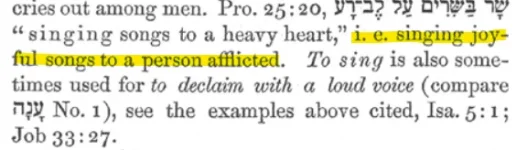
Pro 25:20 - As he that taketh away a garment in cold weather, and as vinegar upon nitre, so is he that singeth songs to an heavy heart.

Gesenius' Hebrew-Chaldee Lexicon:

1788953321471.webp
 
Back
Top