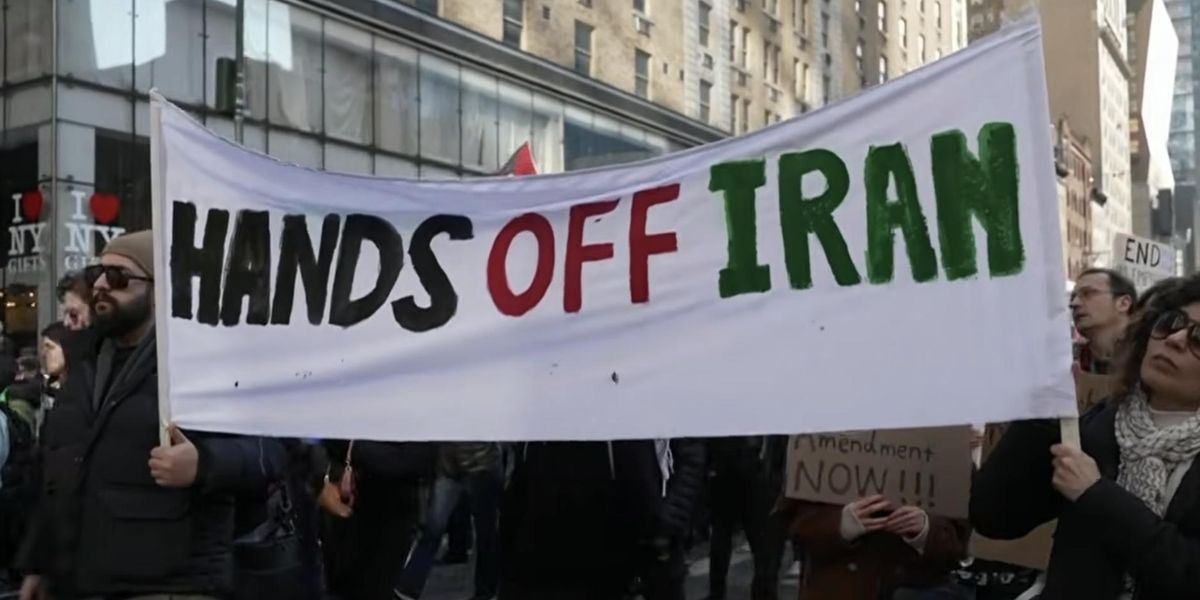
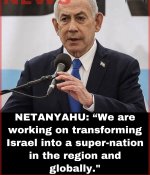
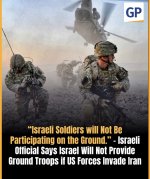
Iran, the next war.

1774962531066.jpeg

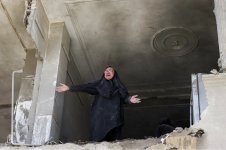
US-Israeli attacks destroy residential buildings in Tehran.
 
Most American Jews oppose Trump's war in Iran:


"A new J Street poll finds 60% of American Jews oppose the U.S. war on Iran.

"The poll of American Jews across the political spectrum, commissioned by J Street and conducted by GBAO strategies, found that 77% of respondents do not believe President Trump has a clear plan and mission for the war in Iran.

"Nearly two-thirds, or 63%, of poll respondents agreed that concerns about Iran’s nuclear program were best solved through diplomacy and sanctions; only 37% agreed they were best addressed with military action. Meanwhile, 58% of respondents agreed that U.S. military action against Iran weakens the U.S., rather than strengthening it.

"As members of J Street’s leadership point out, the findings indicate that most Jewish Americans want peace.

“'This data is a wake-up call for anyone claiming to speak for the American Jewish community while beating the drums of war,' J Street President Jeremy Ben-Ami said. 'Most American Jews see this war for what it is: A reckless, unforced error by a President who has no clear, achievable goals or an exit strategy.'"
 
1775065872078.jpeg

I tried telling yall but yall don’t wanna listen.
 
1775152059108.jpeg

Is this a surprise to anyone? Iraq all over again.
 
Last edited:
As of 2026, 37 U.S. states have adopted or referenced the IHRA definition of antisemitism in some form. These are mostly used in schools, civil rights cases, and government policy. They are not direct criminal laws, but they guide
how complaints are judged.

What's Included:
The IHRA definition outlines examples such as:
Denying Jewish self-determination.
Applying double standards to Israel.
Holding Jews collectively responsible for Israel's actions.

Certain religious or historical claims, depending on context.

Where the Concern Is:
The issue isn't the intent, it's the scope. The language is open to interpretation, which means political or religious speech can be labeled as discriminatory depending on who's enforcing it.

What This Turns Into:
Once these definitions are built into policy, they start influencing how speech is treated in real situations, classrooms, workplaces, and public platforms.

Why It Matters:
Even without criminal charges, people can still face consequences based on how their words are interpreted under these guidelines.

If speech depends on how authorities choose to interpret a broad definition, it stops being consistent.
And when it's not consistent, it can be used selectively.
 
During questioning by Jon Ossoff, Tulsi Gabbard was pressed on whether Iran posed an imminent nuclear threat as previously claimed by Donald Trump. The question itself was narrowly framed and legally significant-focused not on policy, but on whether intelligence assessments supported that claim. Rather than answering directly, Gabbard shifted her response to emphasize that defining an "imminent threat" is ultimately a presidential determination, not solely an intelligence conclusion.

From a legal standpoint, this is a classic example of reframing the question to avoid a definitive factual statement. A direct answer would have forced a conflict—either aligning with intelligence assessments that may not support imminence, or validating a political justification for military action. By redirecting to the issue of authority, Gabbard avoided making a statement that could contradict intelligence findings or expose inconsistencies between intelligence and policy decisions.

This type of response is often described as jurisdictional deflection-staying technically accurate while sidestepping the core issue. The tension in the exchange reflects a deeper concern: whether there is a gap between what intelligence agencies assess and how that information is presented publicly to justify strategic decisions. That distinction is critical in matters of national security, where the line between analysis and action can carry significant legal and geopolitical consequences.


Sources:
U.S. Senate hearing footage - Exchange between Tulsi Gabbard and Jon Ossott
PBS NewsHour - Coverage of intelligence assessments on Iran
Reuters - Reporting on U.S. claims regarding Iran nuclear threat
U.S. intelligence community public statements on Iran nuclear capabilities
 
I just found out that it’s 100% legal to marry an 8 year old girl in Afghanistan. I thought we went there to liberate these people?

Will Iran be any different?
 
I just found out that it’s 100% legal to marry an 8 year old girl in Afghanistan. I thought we went there to liberate these people?

We did. We gave Afghanistan self-determination. They established an Islamic republic, whose leadership was hopelessly corrupt, and then when the U.S. made a mess of pulling out in 2021, it collapsed and the Taliban got in again.

Good job, Joe. *polite applause*

Will Iran be any different?

The pattern in the Middle East has generally been a return to authoritarianism after a popular uprising, which may have even deposed longstanding dictators (e.g. Libya, Egypt), led to reforms. The "Arab Spring" in countries like Egypt, Libya, and Algeria didn't last. In Afghanistan, the Taliban just gets worse. The uprisings create instability and a power vacuum, giving the despots an opening to come back in again.

So I fear that Iran probably won't be any different. Though the protest movement is more sustained than the short-lived Arab Spring, and much of the opposition is well-educated and takes secular and progressive opinions. So we'll see.
 
Last edited:
We did. We gave Afghanistan self-determination. They established an Islamic republic, whose leadership was hopelessly corrupt, and then when the U.S. made a mess of pulling out in 2021, it collapsed and the Taliban in again.

Good job, Joe. *polite applause*


The pattern in the Middle East has generally been a return to authoritarianism after a popular uprising, which may have even deposed longstanding dictators (e.g. Libya, Egypt), led to reforms. The "Arab Spring" in countries like Egypt, Libya, and Algeria didn't last. In Afghanistan, the Taliban just gets worse. The uprisings create instability and a power vacuum, giving the despots an opening to come back in again.

So I fear that Iran probably won't be any different.
True. But Israel wants us there so I guess we will continue to bless Gods chosen people so Hod can bless us.

We shouldn’t be there on behalf of a foreign government.
 
True. But Israel wants us there so I guess we will continue to bless Gods chosen people so Hod can bless us.

We shouldn’t be there on behalf of a foreign government.

Please let whoever's opinion this is know that I'm waving my hand dismissively.
 
Please pass on my noncommittal grunt to whoever's opinion you copied.
I read the facts and form my opinion.

I do not google or get my news from mainstream media.

Therefore, my views will be different from many on this topic. If all a person does is take at face value what our government tells us…..well they will have a completely different view.
 
@Ransom you should look up who were Trumps biggest donation came from. That will tell you why we are in Iran. I’m sure you understand that if someone gives someone else money they will want something in return.
 
Back
Top