

The point of the article is that science has always employed design inferences negating their dismissal of ID as unscientific. But I go off on a tangent below.
 evolutionnews.org
As a believer, I, of course, accept the testimony of Scripture and reject the lies of an old earth and the idea of an evolutionary subhuman ancestor of man.
Neanderthalls were human, and it was poverty either as a result of time and chance, or, as Hebrews describes, persecution, that drove them to seek shelter in caves.
But even in the meanness of their existence, they were creative, and sought to adorn their dwellings.
Painting by Neanderthals? Study Makes a Design Inference
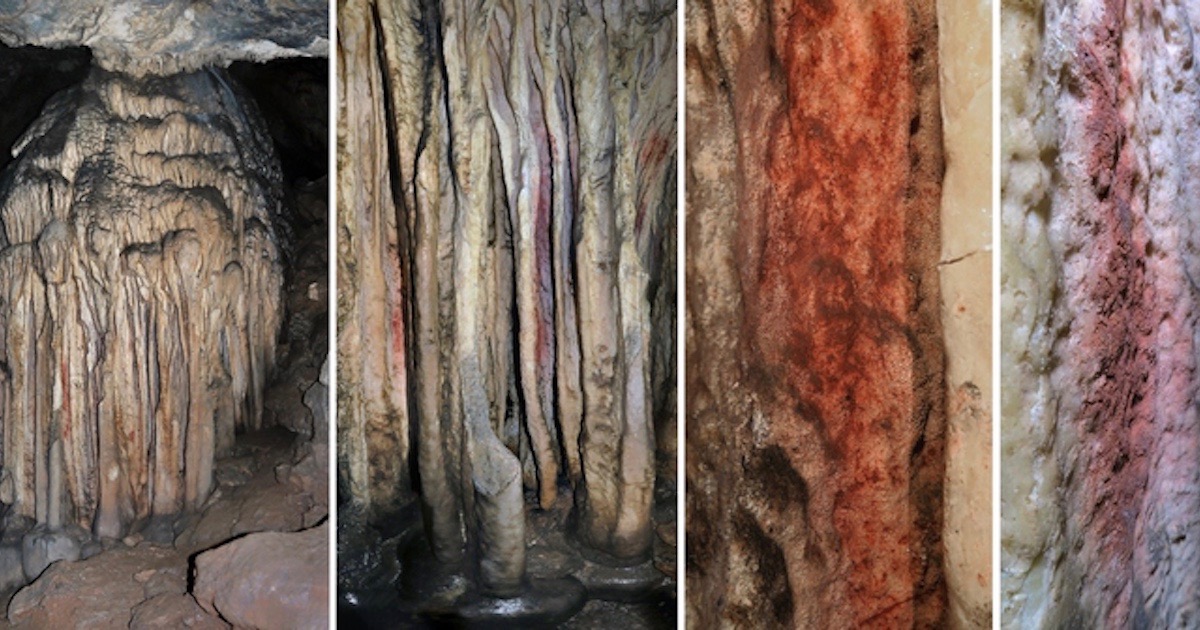
An observation that supports a non-natural origin is that the pigment appears only in a small, conspicuous location.
evolutionnews.org
'A longstanding question among both evolutionists and Darwin-skeptics is whether Neanderthals were capable of symbolic artistic expression. This debate has gone back and forth for years and a new study in Proceedings of the National Academy of Sciences adds to the conversation by making a detailed analysis leading to a design inference that supports painting by Neanderthals. The study looked at the Cueva (Cave) de Ardales in Málaga, Spain which contains flowstones that have been stained by iron. A nice example of what these iron-stained flowstones look like can be seen here. The question is whether the iron-staining is the result of natural processes (e.g., flowing water depositing iron oxide) or deliberate painting using some kind of an ochre-based pigment. The study ultimately makes a design inference — the iron-staining is the result of real Neanderthal painting...'
...
'Beautiful and Intricate Patterns'
...
'A Conspicuous Location'
...
'Will this study be the final word on Neanderthal art? Probably not. The authors make a good case, but as with so many aspects of prehistoric archeology, the evidence is indirect and not clear-cut. They even admit that what they found isn’t exactly what we typically think of as “art”:
'[W]e hypothesize that panel II.A.3 is not “art” in the narrow sense of the word — “the making of objects, images, music, etc. that are beautiful or that express feelings” or “the activity of painting, drawing, and making sculpture” — but rather the result of graphic behaviors intent on perpetuating the symbolic significance of a space.
'The authors made a design inference. Whether they’re right or wrong, the point is this: this study uses intelligent design reasoning, trying to discriminate between naturally caused iron-staining and intelligently caused painting. It provides yet another example showing that ID reasoning is a normal part of the scientific process.'
As a believer, I, of course, accept the testimony of Scripture and reject the lies of an old earth and the idea of an evolutionary subhuman ancestor of man.
Neanderthalls were human, and it was poverty either as a result of time and chance, or, as Hebrews describes, persecution, that drove them to seek shelter in caves.
But even in the meanness of their existence, they were creative, and sought to adorn their dwellings.
Last edited: